About the Site
The Palace of Knossos is an ancient structure discovered on the island of Crete. It was first excavated in 1900 by archaeologist Sir Arthur Evans. Before this discovery, not much was known about the Minoan civilization of Crete. The small amount of information about this civilization came from Greek myths. This site is also the source of many myths, debates, and controversies in the archaeological world today.
Myths
After studying the site, Evans concluded that this palace site was where the myth of King Minos and the Minotaur originated. One of his justifications for coming up with this theory was that the palace's design was labyrinthine, similar to the labyrinth that contained the Minotaur in the myth. There are also double-axe symbols, or labrys, engraved on the palace's columns. Although this theory was widely accepted and very popular at the time of its discovery, now many people are skeptical.
Restoration
Evans' restoration effort of the Palace of Knossos has been critiziced for not being legitimate and true to the past and the Minoan civilization. The use of materials for restoration that were not traditionally used in Minoan architecture have lessened the site's credibility among archaeologists. However, some parts of the palace that Evans restored are now famous and celebrated, like the Throne Room.
What makes this excavation "great"?
This excavation and discovery was important because it taught us so much about a culture that was previously little known about. Many artifacts were discovered here that helped us learn about Minoan every day life and culture. There were many pots and frescos with images of bulls, suggesting that the culture utilized some form of bull-worship and bull sacrifice, perhaps because of the myth of the Minotaur. This also suggests that the Minoans had their own form of religion separate to that of ancient Greece. One of the most important discoveries at this site was about 3,000 writing tablets, written in languages previously unknown to scholars. These languages became known as Linear A and Linear B. The use of a different language further proves that the Minoans were a unique civilization in their own right.
http://www.athenapub.com/11evans.htm
Wednesday, November 14, 2012
Thursday, October 25, 2012
Pompeii
Pompeii: Whats New?
The ancient site has gotten a few new facelifts as of recently
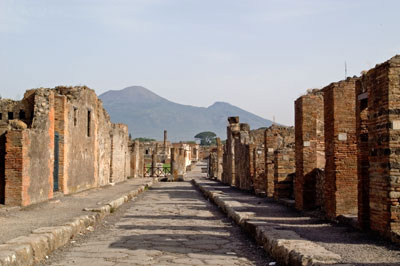
Everyone has heard of the ancient city of Pompeii, destroyed by Mount Vesuvius, covered in ash and soot, and preserving the victims bodies perfectly, almost as if we could step back in time and look at all the carnage and disarray that occurred on that fateful day in 79A.D. The Pompeii site was first excavated in 1748. So a lot has changed since then, especially technology. Technology that can help preserve this site, actually.
Back in the day, excavators would apply a varnish to prevent the decay of the walls, but today, thats just not gonna cut it. Pompeii is in decay because if its incredibly old structures, but the European Union is taking steps to ensure the site of Pompeii, and its sister site, Herculeneum, are preserved properly. Also back in the day, the open air excavations we're the norm. Nowadays, there have to be closed excavations to keep the newly found
One of the projects most famous aspects is the bodies of the deceased Romans preserved in a plaster mold. Just recently, Estelle Lazer examined the bodies, and found that the bodies are not, in fact, the old, the young, sick, and women, but people of types, healthy and sick, young and old, man and woman. Lazer obtained permission to study these bodies with an x-ray, and can now find out how these victims boht lived, and died.
Sadly, funding is a major problem the Pompeii excavation. Without funding, the Pompeii Excavation team will not be able to repair or conserve the collapsed structures and conserve the bodies. Theres even talk of completly renovating the site, and making a theme park! Making a theme park detailing the site may actually seem like a pretty cool idea, as well as create some more interest, and more money, but it would truly destroy the integrity of this ancient site. Its not flashy, but it shows a side of human history that happens to be well preserved.
Thankfully, after a long excavation, debris has been cleared out of a certain site, and a bathouse and a villa are slowly, but surely emerging from the ground.
Monday, October 22, 2012
Troy
The United Nation Educational Scientific and Cultural Organization, or UNESCO, is a group that preserves and promotes archaeological sites. One such site is Troy, the city described by Homer in the Iliad. This ancient city is located in modern-day Turkey and has become a major tourist destination thanks to support from UNESCO.
What makes this sight eligable for UNESCO's support?
According to UNESCO, Troy "is of immense significance in the understanding of the development of European civilization at a critical stage in its early development". The organization then goes on to say that this site has immense cultural importance because of the influence the Iliad had over the creative arts.
How does UNESCO protect this site?
All sites on UNESCO's World Heritage List are given different measures of protection and are preserved as close to their original state as possible.
How does UNESCO promote this site?
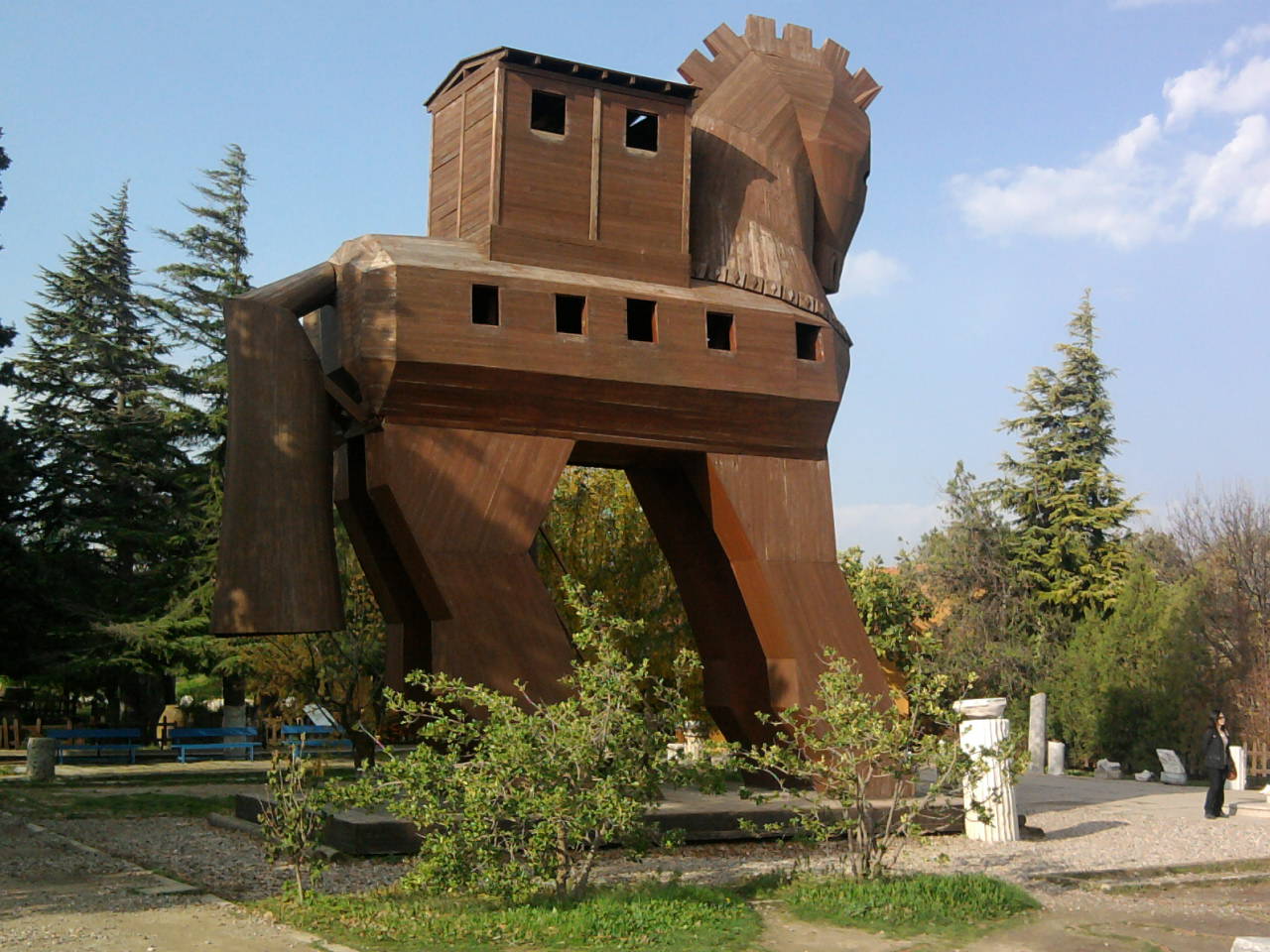
The inclusion of Troy on UNESCO's World Heritage List makes it a major tourist destination, even though there is not much to do besides view the ruins. However, there is a replication of the Trojan Horse to entertain viewers and help them connect with the past.
The main question that we need to ask is, Does Troy really deserve to be on the World Heritage List? It is important to preserve this site because of its importance to history and the creative arts, but tourism takes away from its historical significance. Tourists visit this site and are upset that there is nothing to see except ruins of partially destroyed walls and a fake Trojan Horse. Maybe UNESCO should create two lists: one dedicated to historical sites that deserve to be preserved, and another for sites that are good tourist destinations. UNESCO's partnership with TripAdvisor, a travel website, is further evidence of the corruption of this system. While this organization has seemingly good intentions, it has turned into a money making, tourist attracting business.
http://whc.unesco.org/en/list/849/
http://www.lonelyplanet.com/travelblogs/922/91335/Visiting+Ancient+Troy+%E2%80%93+Trojan+Horse+and+All?destId=360870
What makes this sight eligable for UNESCO's support?
According to UNESCO, Troy "is of immense significance in the understanding of the development of European civilization at a critical stage in its early development". The organization then goes on to say that this site has immense cultural importance because of the influence the Iliad had over the creative arts.
How does UNESCO protect this site?
All sites on UNESCO's World Heritage List are given different measures of protection and are preserved as close to their original state as possible.
How does UNESCO promote this site?
The inclusion of Troy on UNESCO's World Heritage List makes it a major tourist destination, even though there is not much to do besides view the ruins. However, there is a replication of the Trojan Horse to entertain viewers and help them connect with the past.
The main question that we need to ask is, Does Troy really deserve to be on the World Heritage List? It is important to preserve this site because of its importance to history and the creative arts, but tourism takes away from its historical significance. Tourists visit this site and are upset that there is nothing to see except ruins of partially destroyed walls and a fake Trojan Horse. Maybe UNESCO should create two lists: one dedicated to historical sites that deserve to be preserved, and another for sites that are good tourist destinations. UNESCO's partnership with TripAdvisor, a travel website, is further evidence of the corruption of this system. While this organization has seemingly good intentions, it has turned into a money making, tourist attracting business.
http://whc.unesco.org/en/list/849/
http://www.lonelyplanet.com/travelblogs/922/91335/Visiting+Ancient+Troy+%E2%80%93+Trojan+Horse+and+All?destId=360870
Monday, October 15, 2012
King Tut
The Remains of a Young King
As I searched for Egyptian contemporary archaeology, I stumbled upon the
website of the great King Tutankhamun. During a cursory glance at the
website, I had an impression that the site was geared towards tourism
due to the slideshow displayed on the home page. In this slideshow
pictures of Prince Phillip and celebrities such as, Kanye West, are
shown viewing the King Tut exhibition.
Below this slideshow, links connecting to ticket exhibitions, the gift shop and hotel packages are available indicating that the site is geared towards sightseers and acquiring money.
Besides the touristy aspect of the website, tabs across the top include information about the actual exhibit and excavations. Although the site does not include an in-depth analysis of King Tut's history, I did learn that he was born in 1341 BC during the Amarna Age. Because the tomb was securely preserved for more than 3000 years, it was uncovered almost perfectly. King Tut was not as famous as the other pharaohs of his day, but in
modern archaeology the young king's tomb proves to be a vital source of information.
Workmen accidentally uncovered the steps of King Tut's tomb on November 4th, 1922 and soon enough British archaeologist, Howard Carter, continued to excavate until he found eleven stairs and a sealed door leading to the tomb. Carter quickly sent a telegram to Lord Carnarvon describing the site as a 'wonderful discovery'. It is fitting to say that no one knew how revolutionary this discovery was at that time.
After King Tut's tomb began gaining increasing popularity, the story of the Curse of King Tut became extremely famous. It was believed that the tombs of pharaohs had contained curses for those who dared to enter the tombs. Incidentally Lord Carnarvon, who funded the excavation of the tomb, died less than six months after the tomb was opened. Even though no such curse inscribed hieroglyphics were found, the media twisted the story to make it more appealing. Howard Carter, who initially found the tomb, did not pass away until seventeen years after the discovery!
According to the official King Tut website, the exhibition of the teenage pharaoh came to be the most popular exhibition of all time. To this day, more than nine million people have viewed this incredible exhibit. Finally the tomb of King Tut is scheduled to return to Egypt, after the final showing in Seattle on January 6th, 2013. After all this time of touring the United States and the world, King Tut will rest in its originating country. This spectacular exhibition is organized by National Geographic, Arts and Exhibitions
International and AEG Exhibitions and the Egyptian
Ministry of State for Antiquities. Together the United States and Egypt have worked together to preserve the fragile exhibition while informing the world of the life of the ancient Egyptians. A majority of the proceeds collected from the tour dates are even sent to Egypt for restoration projects and conservations, of which one of their projects is to construct a museum near the Pyramids of Giza. It only seems fair that the prized King Tut exhibition will be returned to Egypt now.
Subscribe to:
Posts (Atom)